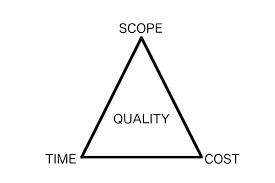
If you've taken any Project Management courses, you've heard of the Project Management triangle. (If you've taken Project Management from me, you've heard it plenty of times.) It's the idea that there are three main competing constraints for any project: time, cost, scope. I usually add a fourth: quality. Any one of these constraints can be easily reduced, but if you reduce one, you can expect that at least one of the other three will be negatively affected.
For example, let's say there's a project with a hard deadline (time), but at the last minute the client tells you they need extra functionality added to the app (more scope). The other two constraints are cost and quality. Since you have a hard deadline, you won't be able to extend the time. So, instead, you have to either lower the quality by not thoroughly testing the new functionality, or bring in an extra developer (i.e. increase the cost). Either way, one of the other constraints just got "dinged".
Or, let's say the client wants you to cut costs by eliminating two people from the team. But you still have the same scope of work, same deadline, and quality you've promised to deliver. So which of the three is going to be negatively affected? You'd probably need to extend the deadline, since you no longer have the same manpower. Or you could keep the same deadline and cut scope. Either way, something's gotta give.
How does understanding the triangle help you manage projects? First, and most importantly, this concept helps to educate your clients on tradeoffs.
Second, by proactively pointing out the tradeoffs, you can demonstrate your competency as a Project Manager while also setting clear expectations with your client. Nobody likes nasty surprises, so you get to be the bearer of good news when you explain how your decision-making will maintain the level of quality your client has come to expect from you.
The bottom line? The PM triangle isn't just for nerds. Although it is pretty nerdy.